
Why Your Dog Doesn’t Listen When It Matters Most
Why Your Dog Doesn’t Listen When It Matters Most
He’s perfect in the kitchen. Sit, down, stay — nailed it every time.
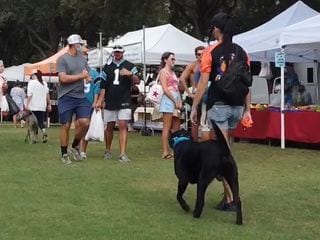
Then you get to the park and it’s like he’s never heard a word you’ve said in his life. He blows off your recall, drags you toward every dog in sight, and you’re standing there repeating “come” like a broken record while strangers pretend not to watch.
If that sounds familiar, you’re not alone. It’s the #1 frustration we hear from owners — and it’s exactly what off leash dog training Charlotte is designed to fix.
Your dog isn’t being stubborn — he just doesn’t generalize
Here’s what most owners never get told: dogs don’t generalize well. Your dog didn’t learn “sit means sit everywhere.” He learned “sit means sit in the kitchen when mom has a treat in her hand.”
The AKC calls the fix “proofing” — making sure your dog understands a behavior no matter the environment or what’s going on around them. Until a command is proofed, your dog honestly doesn’t know the rules apply outside your living room. He’s not defying you. He just hasn’t been taught yet. (The AKC has a great breakdown of how proofing works here: Proofing Your Dog’s Behavior – AKC)
Think about it from your dog’s perspective. Everything they learned happened in one calm, boring room. Then you take them to a park full of smells, dogs, kids, and squirrels — a completely different world — and expect the same performance. That’s like learning to drive in an empty parking lot and then being dropped onto the highway at rush hour.
The three Ds: distance, duration, distraction
Every reliable behavior comes down to three things: how far away you are (distance), how long your dog has to hold it (duration), and what’s going on around them (distraction).
Most training falls apart because people crank up all three at once. They go from practicing “stay” in a quiet hallway to expecting it at a busy park on a Saturday — and then wonder why it failed.
The secret is building one at a time. Get the behavior solid at a distance first. Then add duration. Then — and only then — start adding distractions. Layer it, don’t leap.
This is the unglamorous part of dog training that actually matters most. Anybody can get a sit in a calm room. Reliability is built in the messy middle — the parking lots, the trails, the patios, the front yard when the neighbor’s dog walks by. If your training never leaves the living room, your dog’s obedience never will either.
Why treat-only training falls apart at the park
Here’s an uncomfortable truth: if your dog only listens when there’s food in your hand, they don’t actually know the behavior — they’ve just learned to gamble.
At home, you’re the most interesting thing in the room, so a treat wins. At the park, you’re competing with squirrels, other dogs, and a thousand smells — and a little biscuit doesn’t stand a chance. That’s not a motivation problem. It’s a clarity problem.
Dogs need to understand that commands aren’t suggestions and they aren’t optional when something more fun shows up. That comes from clear, consistent communication — yes to fair corrections, not just cookies. Our off leash dog training Charlotte uses balanced methods because real life doesn’t pause while you dig through your treat pouch.
What off leash dog training in Charlotte actually changes
This is where our program is different. We don’t just train your dog in a quiet room and hand them back hoping it holds. Our board & trains proof obedience in the real world — around other dogs, people, noises, smells, and all the chaos of everyday life.
Day after day, your dog practices holding commands while life happens around them. Not once, not twice — hundreds of reps across dozens of environments until “down means down” is just who they are, not something they do when conditions are perfect.
That’s what “off leash” really means. Not a party trick. It’s a dog who can hold a down-stay while kids play nearby. A dog who recalls off a squirrel mid-chase. A dog you can actually take places instead of leaving at home.
Like I talked about in my last post, training is about more than commands — it’s about a dog whose state of mind is calm enough to listen no matter what’s happening around them. Distraction-proofing is how you get there.
What a distraction-proof dog actually looks like
Picture this: you’re walking your neighborhood and another dog starts barking and lunging from behind a fence. Your dog glances over — and keeps walking with you. No drama. No embarrassment. Just a calm dog making a good choice.
Or you’re at an outdoor restaurant and your dog settles under the table for an hour while the world goes by. Kids drop food. Dogs walk past. Your dog doesn’t move.
That’s not a fantasy. That’s what our clients live every day after training. And every single one of them started exactly where you are — with a dog who was great in the kitchen and a disaster everywhere else.
It has to work in your real life, not just our facility
Here’s my test for whether training actually worked: can you live your normal life with your dog?
Can you walk your neighborhood without getting dragged? Eat on a patio without a scene? Have guests over without locking the dog away? Take them to the lake, the greenway, your kid’s game?
If the answer is no, the training isn’t done — no matter how many commands your dog “knows.” Knowledge without reliability is just trivia. What you need is a dog who listens when it counts, and that only comes from training around real distractions, not avoiding them.
So what do you do about it?
Start by being honest about where your dog actually is. If they only listen at home, they don’t really know it yet — and that’s okay. It just means the proofing phase hasn’t happened. That’s exactly what our off leash dog training in Charlotte is built to fix.
That’s literally what our training programs are designed for. Whether it’s a board & train or private lessons, we train around the distractions your dog will actually face in your life — then we teach you how to keep it going at home, so the reliability sticks.
Call us at (704) 368-3526 for a free phone consultation. Tell us where your dog checks out, and we’ll tell you honestly what it’ll take to fix it.
Real dogs. Real distractions. Real reliability.


